
Running Legacy & Modern Systems Together
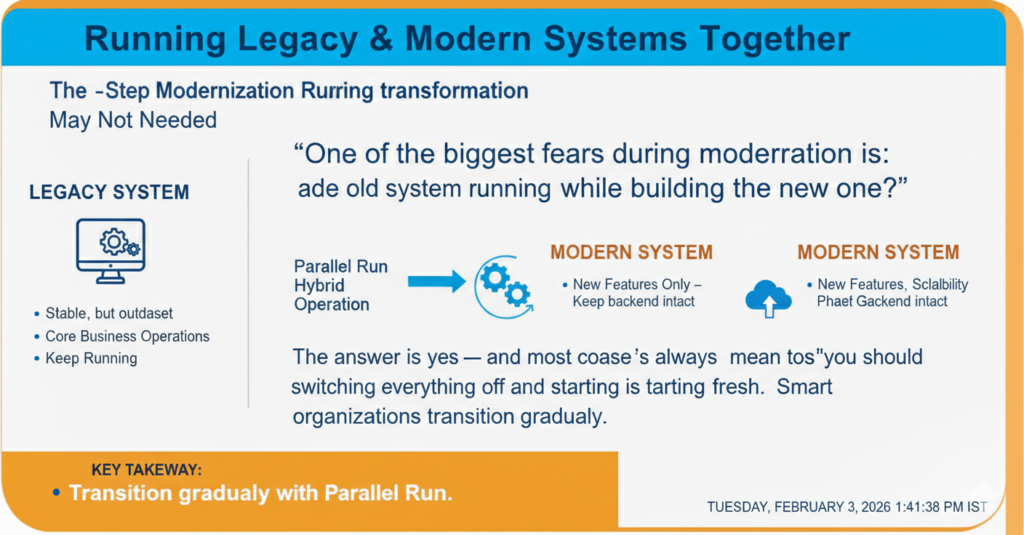
One of the biggest fears during modernization is:
“Can we keep the old system running while building the new one?”
The answer is yes — and in most cases, you should.
This approach is called Parallel Run or Hybrid Operation.
Modernization does not always mean switching everything off and starting fresh.
Smart organizations transition gradually.
Why Run Both Systems Together?
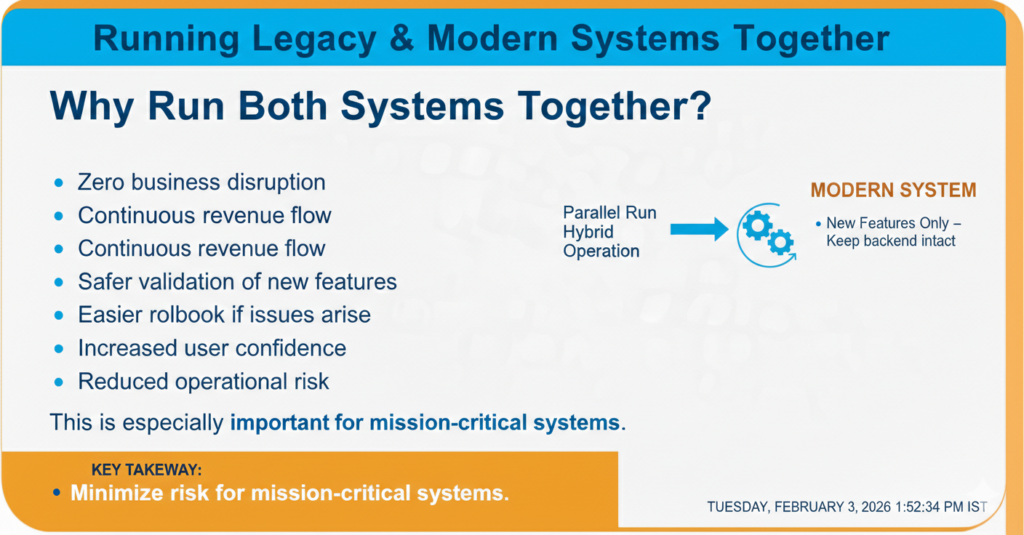
Zero business disruption
Continuous revenue flow
Safer validation of new features
Easier rollback if issues arise
Increased user confidence
Reduced operational risk
This is especially important for mission‑critical systems.
Common Parallel Strategies
1. Module‑by‑Module Replacement
Replace one feature at a time
Old system handles remaining modules
Lowest risk approach
2. API Bridge Approach
Legacy system continues running
New services interact through APIs
Gradual backend transformation
3. Database Synchronization
Both systems share or sync data
Requires strict data governance
Prevents data divergence
4. User Group Migration
Move specific departments or regions first
Collect feedback
Expand rollout gradually
Key Challenges
Running two systems is safe, but not free of complexity:
Data consistency issues
Increased infrastructure cost
Dual maintenance effort
Integration complexity
User confusion if UI differs too much
Planning and monitoring are critical.
Best Practices
Define clear ownership of each module
Maintain a single source of truth for data
Automate synchronization where possible
Communicate changes to users early
Track performance metrics for both systems
Set a sunset date for legacy components
Parallel run should be temporary, not permanent.
When NOT to Run in Parallel
Extremely high infrastructure cost
Very small applications
Security‑critical vulnerabilities in legacy
Systems with heavy real‑time dependencies
In such cases, a faster cutover may be better.
Success Indicators
Smooth user transition
No data conflicts
Stable performance in both systems
Gradual reduction of legacy usage
Clear retirement milestones
Final Thought
Running legacy and modern systems together is not a weakness —
it is a risk‑management strategy.
The goal is not to maintain two systems forever,
but to ensure business continuity while evolving safely.