
Clean Architecture for Modern Systems
After exposing business logic through APIs, the next step is ensuring the system remains maintainable for the next 10–15 years.
That is where Clean Architecture becomes essential.
Modernization is not only about new technology — it is about long‑term sustainability.
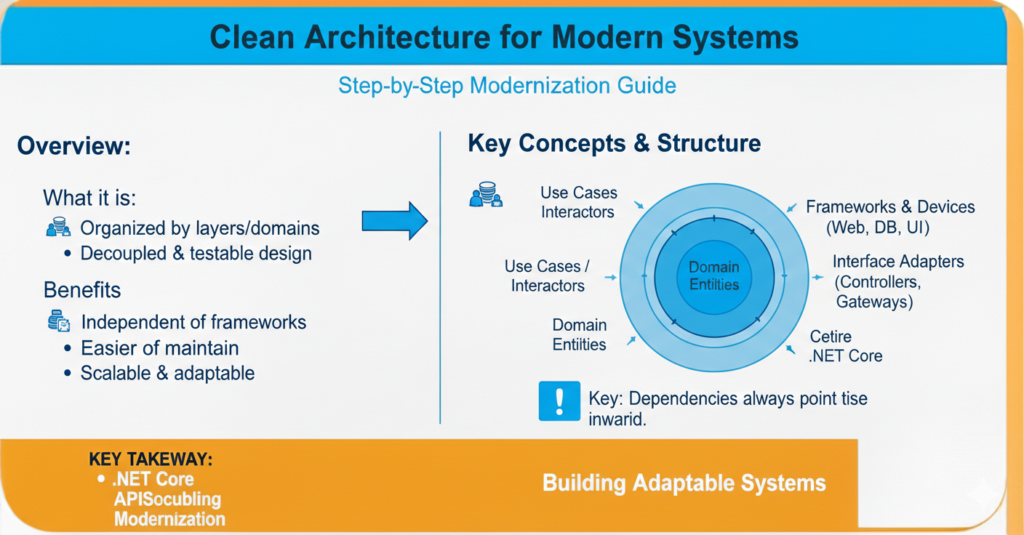
What Is Clean Architecture?
Clean Architecture is a design approach that separates concerns so that:
Business rules do not depend on frameworks
UI can change without breaking backend
Database can be replaced without rewriting logic
Testing becomes easier
Teams can scale development safely
In simple words:
Your core logic should survive technology changes.
Core Principle
Dependencies must always point inward.
Outer layers can depend on inner layers,
but inner layers must never depend on outer layers.
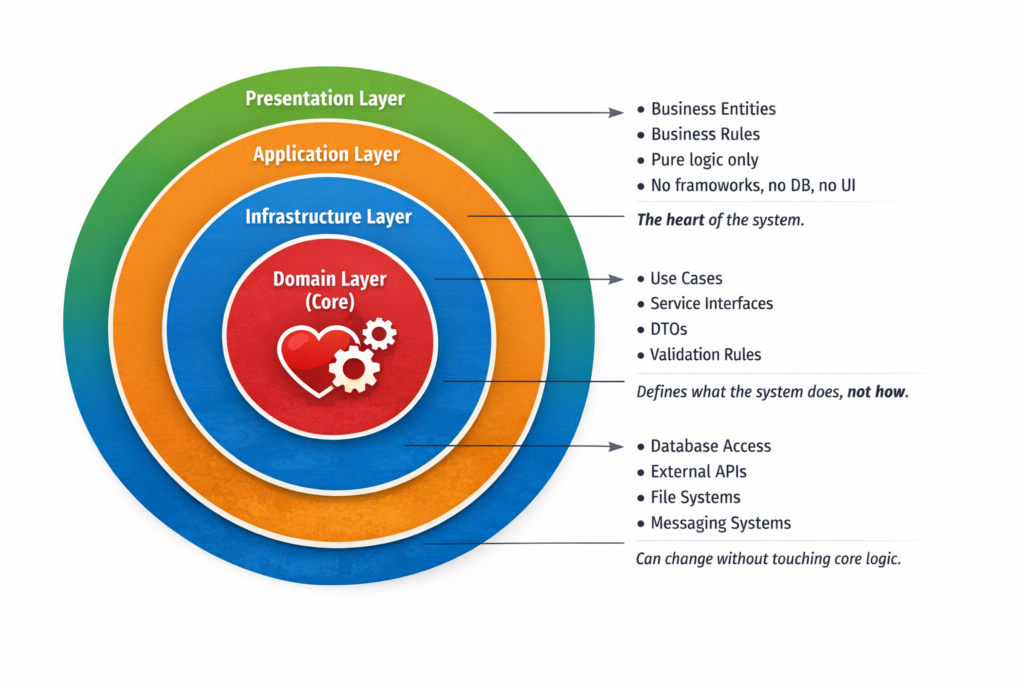
Typical Layer Structure
1. Domain Layer (Core)
Business Entities
Business Rules
Pure logic only
No frameworks, no DB, no UI
This is the heart of the system.
2. Application Layer
Use Cases
Service Interfaces
DTOs
Validation rules
This layer defines what the system does, not how.
3. Infrastructure Layer
Database access
External APIs
File systems
Messaging systems
This layer can change without touching core logic.
4. Presentation Layer
Web APIs
UI frameworks
Controllers
Frontend integrations
This is the outermost layer — the most replaceable.
Why Clean Architecture Matters in Modernization
Legacy systems often suffer from:
UI directly calling database
Business logic inside stored procedures
Tight coupling between modules
Impossible testing
High risk when making changes
Clean Architecture fixes this by creating clear boundaries.
Practical Benefits
Technology Freedom – Change DB, UI, or framework easily
Testability – Unit tests without server or DB
Scalability – Teams can work independently
Maintainability – Easier debugging and onboarding
Longevity – Architecture survives platform shifts
Implementation Tips (.NET Example)
Use Interfaces between layers
Apply Dependency Injection
Keep Controllers Thin
Move logic to Services / Use Cases
Use Repositories only for data access
Avoid framework attributes in Domain layer
Common Mistakes
Putting business logic in controllers
Letting Entity Framework leak into Domain
Over‑engineering with too many layers
Ignoring boundaries “just this once”
Mixing DTOs with Entities
Every shortcut today becomes technical debt tomorrow.
When to Use Clean Architecture
Best suited for:
Enterprise systems
Long‑term products
Multi‑team environments
Systems expected to evolve
Applications with complex business rules
Not always required for small prototypes or short‑lived apps.
Success Indicators
You know it’s working when:
UI redesign does not affect backend
Database switch requires minimal code change
New developers understand structure quickly
Unit tests cover core logic easily
Feature delivery speed increases over time
Final Thought
Clean Architecture is an investment, not an expense.
It ensures your modernization effort does not become tomorrow’s legacy again.
You are not just building APIs —
you are building a system that can evolve without fear.