
Extracting Legacy Business Logic Safely
When organizations begin modernization, the biggest hidden risk is not UI, not database, not infrastructure — it is Business Logic.
This logic is the true intellectual property of the system. If it is lost or misunderstood, modernization fails.
What Is Legacy Business Logic?
Business logic is the set of rules, calculations, validations, and workflows that make the application behave the way the business expects.
Examples:
Tax or pricing calculations
Approval workflows
Eligibility rules
Discount logic
Reporting formulas
Hidden “if–else” conditions written years ago
In legacy systems, this logic is often:
Scattered across UI, DB, and backend
Poorly documented
Mixed with presentation code
Dependent on outdated libraries
Why Extraction Is Critical
Modernization without safe extraction leads to:
Functional mismatches
Revenue loss
Compliance issues
User distrust
Re‑writing the same bugs unknowingly
Goal: Preserve behavior while improving architecture.
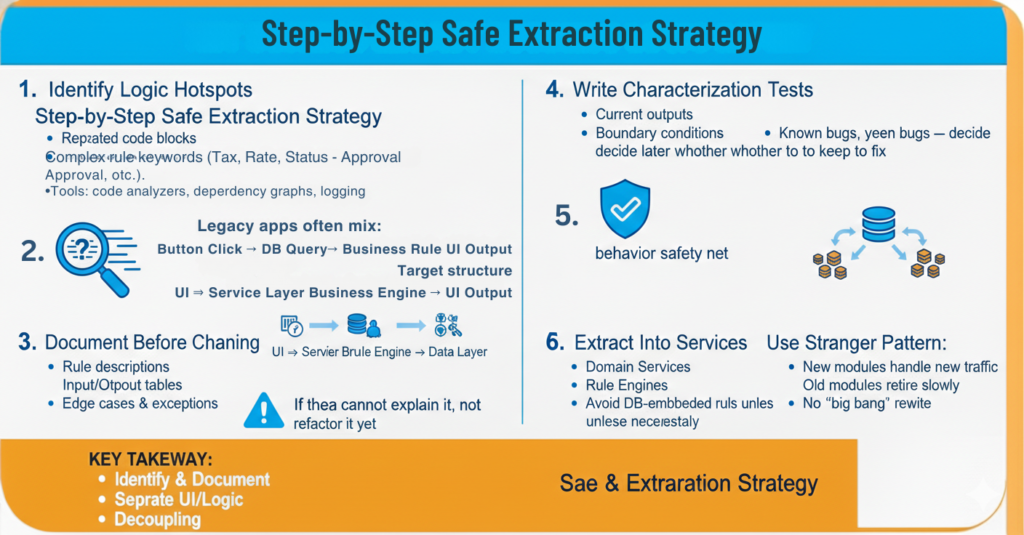
Step‑by‑Step Safe Extraction Strategy
1. Identify Logic Hotspots
Search for:
Large functions / stored procedures
Repeated code blocks
Complex condition trees
Business rule keywords (Tax, Rate, Status, Approval, etc.)
Tools: code analyzers, dependency graphs, logging.
2. Separate UI From Logic
Legacy apps often mix:
Button Click → DB Query → Business Rule → UI Output
Target structure:
UI → Service Layer → Business Rule Engine → Data Layer
3. Document Before Changing
Create:
Rule descriptions
Input/Output tables
Flow diagrams
Edge cases & exceptions
If you cannot explain it, do not refactor it yet.
4. Write Characterization Tests
Before rewriting logic, create tests that confirm:
Current outputs
Boundary conditions
Known bugs (yes, even bugs — decide later whether to keep or fix)
This forms a behavior safety net.
5. Extract Into Services
Move logic into:
Domain Services
Rule Engines
Micro‑modules
Shared Libraries
Avoid DB‑embedded rules unless absolutely necessary.
6. Refactor Gradually
Use Strangler Pattern:
New modules handle new traffic
Old modules retire slowly
No “big bang” rewrite
Common Mistakes to Avoid
Rewriting logic from scratch
Assuming documentation is correct
Ignoring edge cases
Mixing refactor + feature changes
Skipping automated tests
Recommended Modern Targets
.NET Core / Java Spring Services
Clean Architecture / Hexagonal Architecture
Domain‑Driven Design (DDD)
Rule Engines for complex decision trees
Success Indicators
You know extraction is successful when:
Outputs match legacy behavior
Logic is readable & testable
UI changes don’t affect rules
New developers understand the flow quickly
Deployment becomes independent of UI
Final Thought
Modernization is not deletion — it is preservation with evolution.
Extracting business logic safely ensures the organization keeps its knowledge, revenue rules, and operational DNA while gaining scalability and maintainability.
Backend modernization begins here.